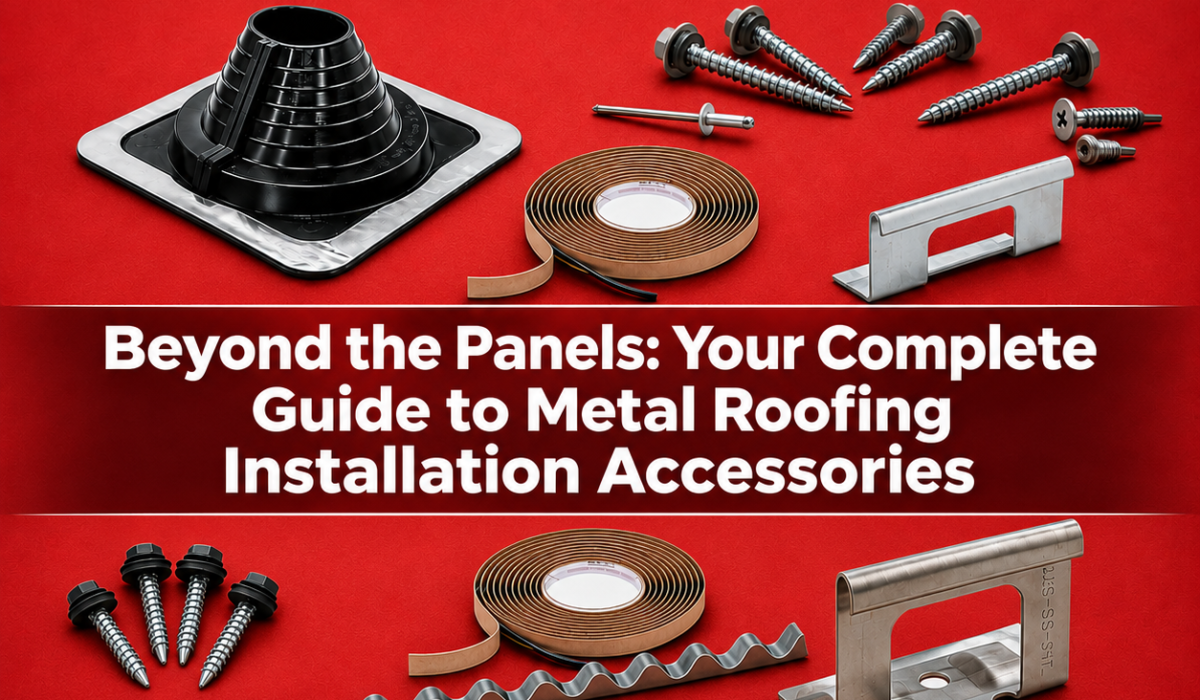
Beyond the Panels: Your Complete Guide to Metal Roofing Installation Accessories
When planning a metal roof installation, most people start by choosing their metal panels, color, and gauge. While those decisions are important, there’s much more to a successful roofing project than the panels themselves.
From pipe boots and underlayment to sealants, flashing, fasteners, and snow guards, the smaller components of a roofing system play a big role in keeping your building protected.
Whether you’re a professional roofing contractor, a builder working on a new construction project, or a homeowner tackling a DIY installation, knowing which accessories you need before starting can save time, prevent unnecessary trips for materials, and help avoid costly problems down the road.
At Lyon Metal Roofing & Home Supply, we understand that a reliable metal roof requires more than quality panels. That’s why we’re breaking down some of the most important metal roofing installation accessories, what they do, and when you might need them.
1. Roofing Underlayment: An Extra Layer of Protection
Underlayment is one of the most important materials installed beneath a metal roof. It provides a secondary layer of protection between the roofing panels and the roof decking.
Although metal roofing is designed to shed water, moisture can still find its way beneath the panels through wind-driven rain, condensation, or improperly sealed areas. Properly selected and installed underlayment helps protect the underlying structure.
Common types of roofing underlayment include:
Synthetic Underlayment: A durable, lightweight material designed to provide a water-shedding layer beneath the roof covering. Synthetic options, including products from Palisade, are commonly used in residential and commercial roofing projects.
High-Temperature Ice & Water Shield: A self-adhering waterproofing membrane often used in vulnerable areas such as valleys, eaves, and roof penetrations. Products specifically rated for the elevated temperatures beneath metal roofing are especially important.
Traditional Roofing Felt: An asphalt-saturated material used in some roofing applications. However, compatibility with the selected metal roofing system, temperature conditions, and installation instructions should be verified.
Something to consider: In areas of Northeast Tennessee, Southwest Virginia, Western North Carolina, and Upstate South Carolina that experience freezing temperatures and winter weather, additional protection against ice dams may be necessary.
Always confirm the proper underlayment requirements for your particular metal roofing system and local building codes. Standard synthetic underlayment and self-adhered ice-and-water membranes serve different purposes and aren’t automatically interchangeable.
2. Metal Roofing Screws & Fasteners: Holding Everything Together
Choosing the right screws is just as important as selecting the correct panels.
Different metal roofing systems require different fasteners, depending on the panel profile and the material you’re fastening into.
Wood Grip Screws: Commonly used when installing exposed-fastener metal roofing into wood decking or framing.
Self-Drilling Screws: Designed for fastening metal roofing components to appropriate metal substrates without requiring a separate pilot hole in many applications.
Stitch Screws: Shorter fasteners typically used to connect overlapping metal panels, flashings, and other sheet-metal components.
Pancake-Head Screws: Low-profile fasteners frequently used with standing seam clips, cleats, and concealed fastening systems.
Rivets: Often used to secure trim and flashing components where specified.
Exposed roofing fasteners commonly feature sealing washers, often made with EPDM rubber, to help prevent water from entering around the screw.
However, even the right screw can cause problems if installed incorrectly.
Overtightening may damage the washer, while undertightening may prevent it from sealing properly. Fastener length, placement, corrosion resistance, and spacing should follow the specific panel manufacturer’s instructions.
Contractor tip: When ordering panels from Lyon Metal Roofing, make sure your fastener selection matches the roofing profile and whether you’re installing into wood or metal. Don’t forget the correct driver bits!
3. Metal Roofing Trim & Flashing: Directing Water Where It Belongs
Flashing is one of the most important parts of a metal roofing installation, especially around edges, intersections, and changes in roof direction.
Properly designed flashing helps direct water away from vulnerable areas and prevents moisture from entering the roofing system.
Depending on the roof’s design, you may need several different trim profiles.
Ridge Caps: Cover the peak where two roof slopes meet.
Hip Caps: Protect the angled intersection where two roof planes meet along an outward-facing hip.
Eave or Drip Edge Flashing: Helps direct runoff away from the roof decking, fascia, and underlying structure.
Rake or Gable Trim: Finishes and protects the sloped edges of a roof.
Valley Flashing: Channels water where two inward-facing roof slopes intersect.
Sidewall Flashing: Protects locations where roofing runs alongside a vertical wall.
Endwall Flashing: Helps waterproof the intersection where a roof slope meets a wall at its upper end.
Transition Flashing: Used where the pitch of a roof changes.
Chimney and Counterflashing: Specialized flashing used to direct water around chimneys and other masonry features. Larger chimneys may also require a cricket to divert water around the uphill side.
Every roof is different. A simple gable roof may only require a few types of flashing, while a home with multiple rooflines, dormers, and chimneys can require considerably more.
Remember, caulk should never be used as a replacement for properly installed flashing. Flashing should be designed to shed water first, with approved sealants providing additional protection where required.
4. Pipe Boots: Protecting Roof Penetrations
One of the most commonly overlooked metal roofing accessories is the pipe boot, sometimes called a pipe flashing boot or roof jack.
Most residential and commercial roofs have pipes or vents extending through the roofing surface.
These penetrations create potential entry points for water if they aren’t properly sealed.
A pipe boot fits around an appropriate roof penetration and seals the area where the pipe passes through the metal panel.
Standard EPDM Pipe Boots
These flexible rubber boots are commonly used around plumbing vent pipes and other compatible, relatively low-temperature penetrations.
Many feature a flexible metal base that can be formed to fit the roofing profile.
High-Temperature Pipe Boots
Certain roof penetrations experience elevated temperatures and require specially rated flashing materials.
High-temperature silicone pipe boots may be suitable for some applications, but hot exhaust flues, chimneys, and other heat-producing equipment must use the specific code-approved flashing and clearance system required by the equipment manufacturer.
Retrofit or Split Pipe Boots
Sometimes a standard pipe boot cannot be slipped over the top of a pipe.
This may occur around existing electrical service masts or other penetrations that cannot be disconnected.
Retrofit pipe boots are designed to wrap around an existing pipe, allowing the installer to seal the penetration without sliding a one-piece boot over the top.
What should you know before ordering?
Measure the outside diameter of the pipe, identify its purpose and operating temperature, and confirm the boot will work with the metal roofing profile.
Proper placement, compatible sealant, and the manufacturer’s fastening details are critical. Boots should also be positioned so water can drain freely around them.
5. Metal Roofing Caulk, Sealants & Butyl Tape
A metal roof experiences temperature changes throughout the year, causing its components to expand and contract.
That’s why metal roofing requires sealants specifically designed to perform with these conditions.
Not all caulk is suitable for metal roofing.
Roofing-Grade Tube Sealant
Products such as NPC #900 Solar Seal are formulated for use with metal roofing, flashing, and other construction materials.
Depending on the application, approved tube sealants may be used around flashing joints, pipe boots, and other areas requiring a flexible, weather-resistant seal.
Color-matched sealant can also help create a cleaner finished appearance.
Butyl Tape
Butyl tape is a flexible, tacky sealing material commonly supplied in rolls.
Unlike exposed caulk joints, butyl tape is generally installed between overlapping components as part of a concealed sealing detail.
It may be used at panel end laps, flashing overlaps, pipe boot bases, and other designated locations.
Important: Butyl tape and tube sealant aren’t always interchangeable. Their placement and application depend on the particular roofing system.
Avoid using general-purpose household caulk without verifying compatibility with the roofing material and coating. Some sealant chemistries can damage finishes or fail prematurely under rooftop conditions.
6. Foam Closure Strips: Sealing Gaps Beneath Your Panels
Metal roofing panels have raised ribs that create gaps wherever the panel meets certain trim components.
Without the proper closures, those openings can allow wind-driven rain, insects, birds, and debris to enter the roofing system.
Foam closure strips are designed to fill these gaps by matching the panel’s profile.
Inside Closure Strips: Commonly used at the eave or other specified areas where the panel profile needs to be sealed from beneath.
Outside Closure Strips: Commonly installed beneath ridge caps or other trim where the top side of the panel profile must be closed.
Vented Closures: Specialized products that help protect openings while allowing airflow where the roofing system requires ventilation.
A closure strip designed for AG Panel roofing will not necessarily fit PBR, 5V Crimp, or standing seam roofing.
Always match the closure to the exact panel profile and installation detail.
Also, remember that sealing unwanted gaps shouldn’t mean blocking necessary roof ventilation.
7. Snow Guards & Snow Retention Systems
One characteristic of metal roofing is its ability to shed snow.
While that can be beneficial, large amounts of accumulated snow and ice may sometimes release from the roof all at once.
This can create hazards above entryways, sidewalks, vehicles, landscaping, and other areas below the roofline.
Snow guards are designed to manage the movement of snow and ice by helping retain snow on the roof so it can melt or release more gradually.
There are several common styles.
Individual Snow Guards or Snow Shoes: Smaller devices installed in engineered patterns across designated areas of the roof.
Snow Bars and Rail Systems: Continuous snow retention systems designed to help distribute loads across a section of roofing.
Standing Seam Snow Retention Clamps: Specialized attachment systems that can secure snow retention components to compatible standing seams without penetrating the panels.
Lyon Metal Roofing offers different snow-retention accessory options, including snow guards and snow shoes. Your sales representative can help determine which products may be appropriate for your roof profile.
Important consideration: Snow guards aren’t required on every metal roof. Their selection and layout should account for roof pitch, length, panel type, local snowfall, structural capacity, and areas that need protection.
Snow retention systems increase the amount of snow the roof may hold. For that reason, they should be properly designed for the expected loads rather than installed based solely on appearance or guesswork.
8. Insulation, Ventilation & Condensation Control
Another factor to consider during a metal roofing installation is what happens beneath the panels.
Metal roofing can experience condensation when warm, moist air comes into contact with a colder surface.
Depending on the building’s design, condensation control may involve insulation, vapor retarders, ventilation, or specialized roofing components.
For residential homes, proper attic ventilation and insulation are important parts of the overall roofing system.
For agricultural buildings, garages, pole barns, and workshops, the appropriate approach may be different, particularly when the metal panels are installed over open framing.
Products to consider may include roof insulation, insulation tape, vapor-control materials, ridge ventilation components, and soffit ventilation products.
The correct solution depends on whether the building is heated, conditioned, ventilated, or used for moisture-producing activities.
One common mistake: Assuming that installing synthetic roofing underlayment automatically solves every condensation problem. Underlayment primarily serves as a secondary water-shedding layer; it doesn’t replace a properly designed ventilation or vapor-control strategy.
9. Metal Fascia & Gutter Preparation: Finishing the Roofline
Proper water drainage is an important part of any roofing project. While gutters and downspouts help carry rainwater away from a building, the materials installed along the roof’s edge are also important.
Metal fascia provides a clean, finished appearance along the roofline while helping protect the underlying fascia materials from exposure to the elements.
At Lyon Metal Roofing & Home Supply, we manufacture metal fascia that can be incorporated into roofing projects where gutters will be installed.
Although we do not manufacture or supply gutter systems, our metal fascia can help provide the finished roofline needed for a professional-looking gutter installation. Gutters must be securely attached to appropriate structural backing using an approved fastening method, rather than relying on thin metal fascia alone for support.
Contractor tip: If your project will include gutters, plan ahead! Coordinating your fascia, drip edge, and gutter installation before beginning work can help ensure everything fits together properly and directs water where it belongs.
Whether you’re installing a metal roof on a home, garage, or commercial building, don’t overlook the finishing details along the roof’s edge. They can make a noticeable difference in both appearance and long-term performance.
10. Additional Accessories You Might Need
Some materials only become necessary when a roof has particular features or installation requirements.
For example, standing seam systems may require specialized clips, cleats, Z-closures, hemming tools, and other components that aren’t typically used with standard exposed-fastener roofing.
Complex roofs may need custom-bent trim or flat stock, additional flashing materials, roof curbs for equipment, or specialty components around skylights.
Depending on the installation, you may also want to plan for manufacturer-approved touch-up paint, replacement fasteners, compatible sealing washers, and other finishing materials.
Small details can make a big difference in the completed project.
11. Don’t Forget the Right Installation Tools
Even with all the correct materials on-site, a project can come to a halt without the proper tools.
Common tools for metal roofing work include screw guns with adjustable torque control, magnetic nut drivers, metal snips, metal-cutting shears, tape measures, chalk lines, caulking guns, and appropriate hand seamers or bending tools.
Certain standing seam systems also require specialized seaming equipment.
Metal roofing can be slippery and difficult to work on, especially on steep slopes or in wet conditions. Appropriate fall protection, ladders, personal protective equipment, and safe installation practices are essential.
If you’re unfamiliar with roofing work, it’s worth consulting a qualified contractor before attempting an installation.
Frequently Asked Questions About Metal Roofing Accessories
Do I need underlayment beneath a metal roof?
Most residential metal roofing assemblies over solid decking include a specified underlayment system. Requirements vary based on roof design, climate, local codes, and panel type. Some agricultural or engineered metal building systems use different assemblies, so always follow the applicable specifications.
Can I use regular silicone caulk on metal roofing?
Don’t assume a general-purpose silicone product is suitable. Use a sealant approved for your metal roofing system, finish, and particular application. Some silicone products are compatible with metal roofing, but others may cause problems.
Are pipe boots necessary for metal roofs?
Proper flashing is necessary wherever a pipe or similar penetration passes through the roof. Flexible pipe boots are a common solution, but some penetrations require other specialized flashing systems.
Does every metal roof need snow guards?
No. Snow retention requirements depend on the local climate, roof geometry, exposure, and potential hazards below. A properly designed system may be recommended for certain buildings, particularly in areas that experience significant snowfall.
Can I use the same accessories for AG Panel and standing seam roofing?
Not always. Exposed-fastener roofing and standing seam roofing use different fastening and flashing methods. Some accessories can work with multiple profiles, but many must be selected specifically for the panel being installed.
Get the Right Materials for Your Next Roofing Project at Lyon Metal Roofing
A great metal roof starts with quality panels, but the finishing details are what help bring the entire project together.
Whether you’re replacing a roof on your home, installing metal roofing on a barn, or supplying materials for your next contracting job, having the correct accessories on hand can make the installation process smoother.
At Lyon Metal Roofing & Home Supply, we work with homeowners, contractors, roofers, and builders to help them find the materials they need for their projects.
From metal roofing panels and trim to fasteners, underlayment, pipe boots, sealants, and other roofing accessories, our team can help you review your materials list and confirm product compatibility and availability.
With locations serving Tennessee, Virginia, North Carolina, and South Carolina, we’re here to help you prepare for your next project.
Don’t just order the metal. Make sure you have everything you need to complete the roof.
Call or come by one of Our Locations with any questions you may have and we can make sure we get you set up for success for your project.
Rely on Lyon.